How to Start a Security Agency in Karnataka
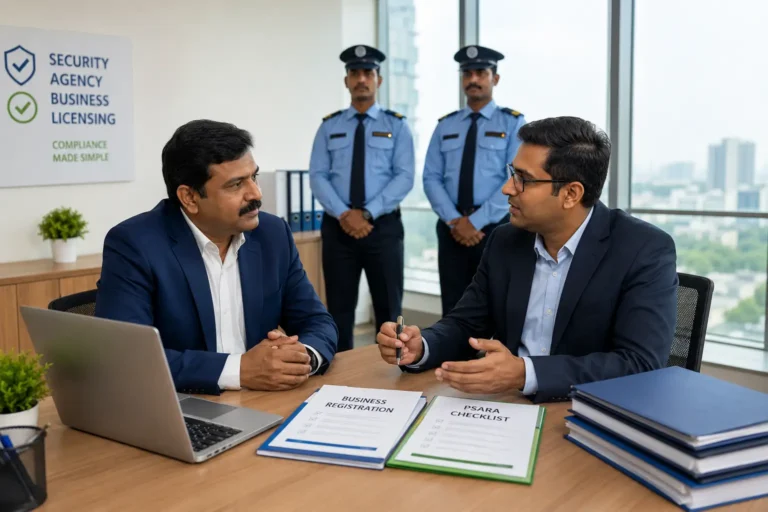
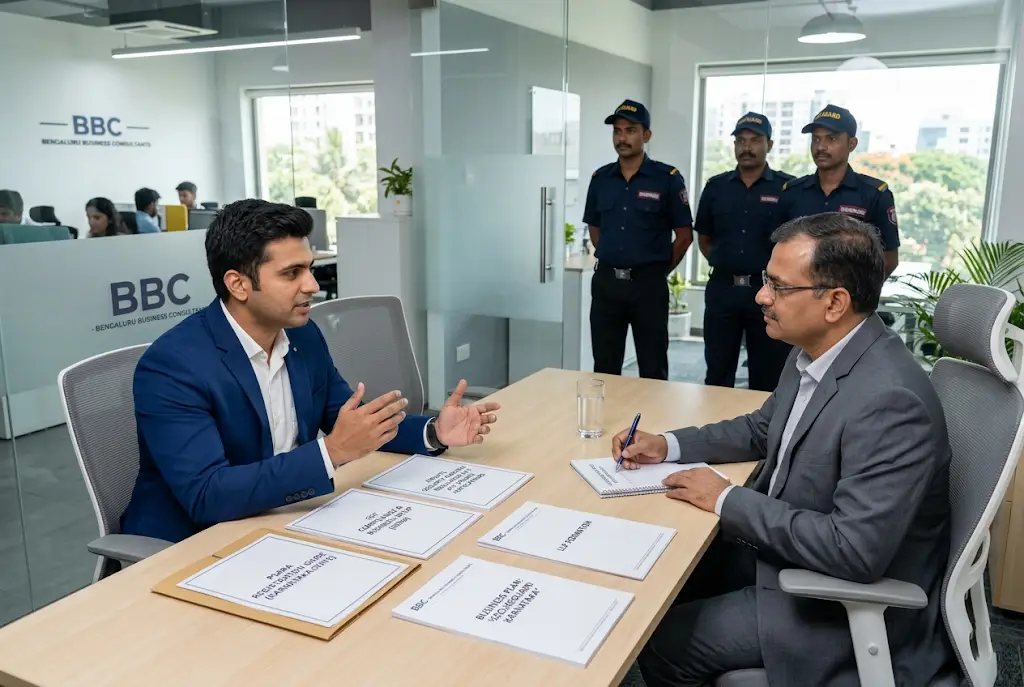
Starting a security agency in Karnataka is not only about hiring guards and finding clients. You need a proper business structure, a valid PSARA license, police verification, security guard training, labour registrations, and tax compliance before you start operations.
If you are searching for How to Start a Security Agency in Karnataka, the direct answer is this: first register your business, set up a physical office, apply for the PSARA license in Karnataka, complete police and antecedent verification, arrange training for guards and supervisors, then take care of GST, Shops and Establishment registration, Professional Tax, PF, ESI, and ongoing record maintenance.
The most important approval is the PSARA license. PSARA stands for the Private Security Agencies Regulation Act, 2005. It regulates private security agencies across India. Karnataka follows its own Karnataka Private Security Agencies Rules under this Act. Without the right license, a private security agency should not provide security guards, supervisors, bodyguards, or similar security services to clients.
Quick Answer: What Do You Need to Start?
Use this page as a founder’s sequence: choose the entity, establish the business basics, plan premises and training, prepare the PSARA application, and address tax, labour or local registrations only when they apply. The commercial owner is PSARA Licence in Karnataka. Do not begin regulated private-security operations before the required licence is in place.
Primary sources verified 26 August 2026: the Private Security Agencies (Regulation) Act, 2005 and the current MHA PSARA portal. Karnataka applicants should confirm the operative State forms, evidence and authority instructions shown at filing time.
To start a security agency in Karnataka, you generally need:
- A registered business entity
- PAN and bank account
- Office address in Karnataka
- PSARA license for the selected district or state area
- Police verification of the applicant, directors, partners, and key persons
- Security guard and supervisor training system
- Shops and Establishment registration
- GST registration, if applicable
- Professional Tax registration in Karnataka
- PF and ESI registration once employee limits apply
- Proper employee records, guard ID cards, uniforms, salary records, and compliance files
For Bengaluru-based agencies, the same PSARA framework applies. The difference is that your office address, local labour registrations, municipal requirements, and employee deployment records should match your actual place of operation.
Why This Matters for Business Owners
The demand for private security services is high in Karnataka. Apartments, tech parks, malls, schools, factories, warehouses, events, hospitals, banks, and offices all need trained guards. Bengaluru alone has a large market because of its commercial and residential growth.
But security is a sensitive service. Clients trust your guards with people, property, access control, visitor movement, cash, equipment, and emergency response. That is why the government regulates private security agencies.
A proper setup helps you:
- Win contracts from companies, apartments, and institutions
- Avoid license rejection or cancellation
- Protect clients from compliance risk
- Build trust with trained and verified guards
- Manage salaries, PF, ESI, and records correctly
- Scale from one district to multiple districts in Karnataka
A weak setup may create serious problems. You may lose contracts, face notices, struggle during police verification, or fail client audits. Many larger clients ask for a PSARA license, GST, PF, ESI, salary records, and training proof before signing a security contract.
The Main License: PSARA Registration in Karnataka
PSARA license is the core legal permission for a private security agency. The license is issued by the State Controlling Authority under the PSARA law and the Karnataka rules.
In Karnataka, the application depends on your operating area. You may apply for:
- One district in Karnataka
- More than one and up to five districts
- The whole state of Karnataka
The government fee structure may vary based on the selected jurisdiction and later notifications. So, always check the latest official Karnataka government or PSARA portal updates before filing.
Once granted, the PSARA license is usually valid for five years unless cancelled earlier. Renewal must be planned before expiry. Do not wait until the last month because renewal also needs updated records and verification.
Who Needs a PSARA License?
You need a PSARA license if your business provides private security services to clients in Karnataka.
This usually includes:
- Security guard services
- Apartment security
- Corporate office security
- Industrial and warehouse security
- Event security manpower
- Bodyguard or personal security services
- Security supervisors
- Security services for institutions, malls, hospitals, and commercial buildings
You may also need extra care if you plan to provide armed guards, cash van security, ATM cash handling support, or bank-related security services. These activities have stricter rules and operational controls.
Who May Not Need a PSARA License?
A business may not need PSARA registration if it only hires guards for its own internal use and does not provide security guards to outside clients as a service. For example, a factory hiring security guards directly for its own premises is different from a company supplying guards to many clients.
But the line can become unclear. If your business trains guards, supplies guards, manages guards for other clients, or bills clients for security manpower, you should check PSARA applicability before starting.
Step-by-Step Checklist: How to Start a Security Agency in Karnataka

Starting a security agency becomes easier when you follow the right order. The steps below explain how to move from idea to compliant operations, including business registration, PSARA licensing, tax registration, labour compliance, guard verification, and client-ready documentation.
1. Choose the Right Business Structure

You can start as a proprietorship, partnership firm, LLP, OPC, or private limited company. For a security agency, LLP or private limited company registration is often better if you plan to work with apartments, corporates, factories, and institutions.
A formal entity makes contracts, bank accounts, GST, PF, ESI, and client onboarding easier. It also helps if you want to expand across Karnataka later.
Before registering the entity, make sure the business object allows private security agency services, manpower services, or allied security services.
2. Set Up a Proper Office Address
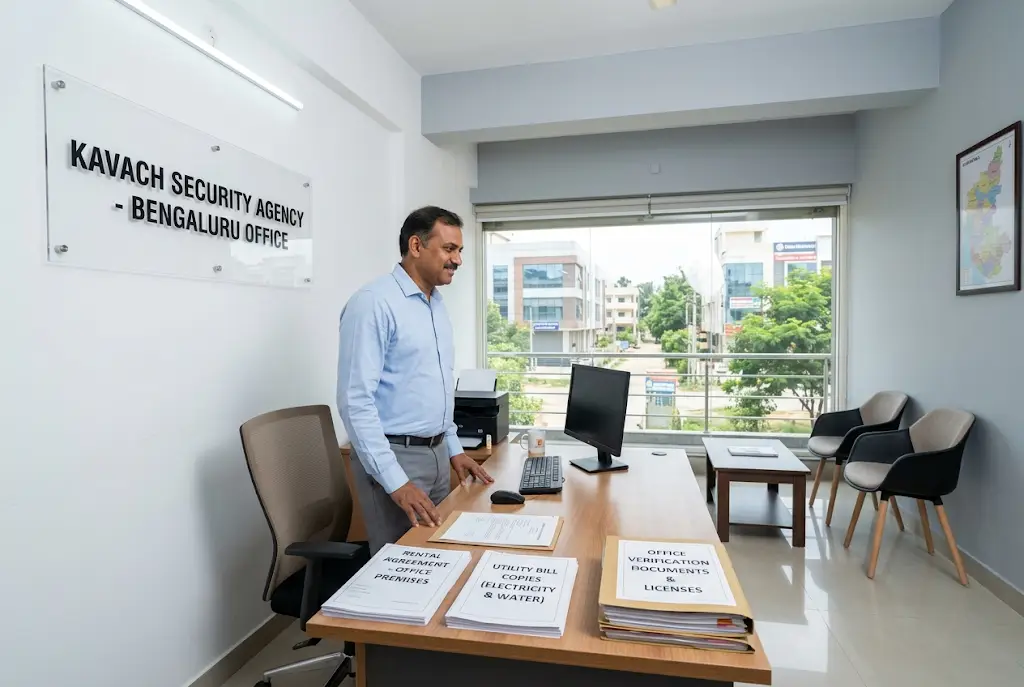
You need a clear place of business in Karnataka. This address may be used for business registration, GST, Shops and Establishment registration, PSARA application, police verification, and client communication.
Keep these documents ready:
• Rental agreement or ownership proof
• Electricity bill or property tax document, if available
• NOC from the owner, where required
• Office photos, if asked
• Board/nameplate at the premises, if required for verification
In Bengaluru, keep your office documentation consistent. Mismatch in address across GST, Shops Act, PSARA, and bank documents can delay approvals.
3. Apply for Shops and Establishment Registration

A security agency office is usually treated as a commercial establishment. In Karnataka, the owner must complete Shops and Establishment registration within the prescribed time after starting business.
The Karnataka Labour Department manages online registration, renewal, amendment, closure, and annual return options through the official e-Karmika portal. The registration certificate should be displayed at the office.
This registration helps prove that your office exists and that your employment records follow Karnataka labour rules.
4. Apply for PSARA License
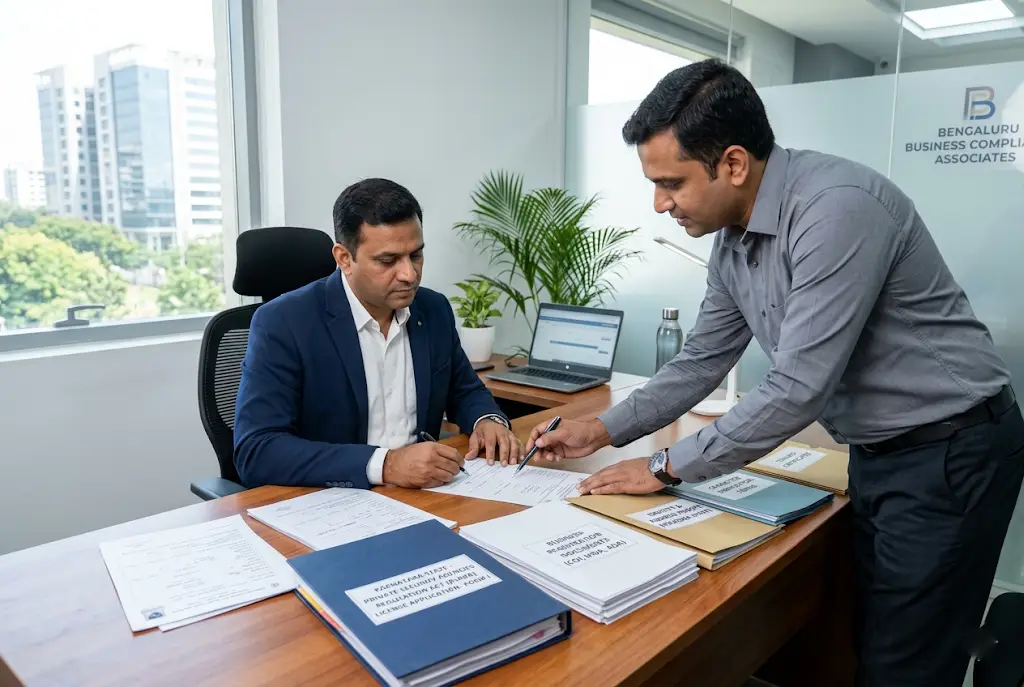
The PSARA application is the main step in this process. The application generally includes details of the applicant, entity, office, directors or partners, area of operation, police verification, training arrangement, and supporting documents.
Common documents include:
• Business registration certificate
• PAN of business and promoters
• Address proof of office
• Identity and address proof of the proprietor, partners, or directors
• Passport-size photos
• Affidavit and declarations under PSARA
• Police verification or antecedent forms
• Training arrangement or training proof
• Uniform, badge, and logo details, if required
• GST and labour registration details, where applicable
Document requirements may change depending on the current portal process, department practice, entity type, and operating area.
5. Complete Police Verification

Police verification is a serious part of the PSARA process. The applicant, directors, partners, majority shareholders, key management persons, guards, and supervisors may need character and antecedent verification.
The purpose is simple: the authority wants to ensure that people running or working in a security agency do not pose a risk to public safety.
Do not hide past cases, address history, or management changes. Misrepresentation can lead to refusal, cancellation, or future legal issues.
6. Arrange Security Guard Training
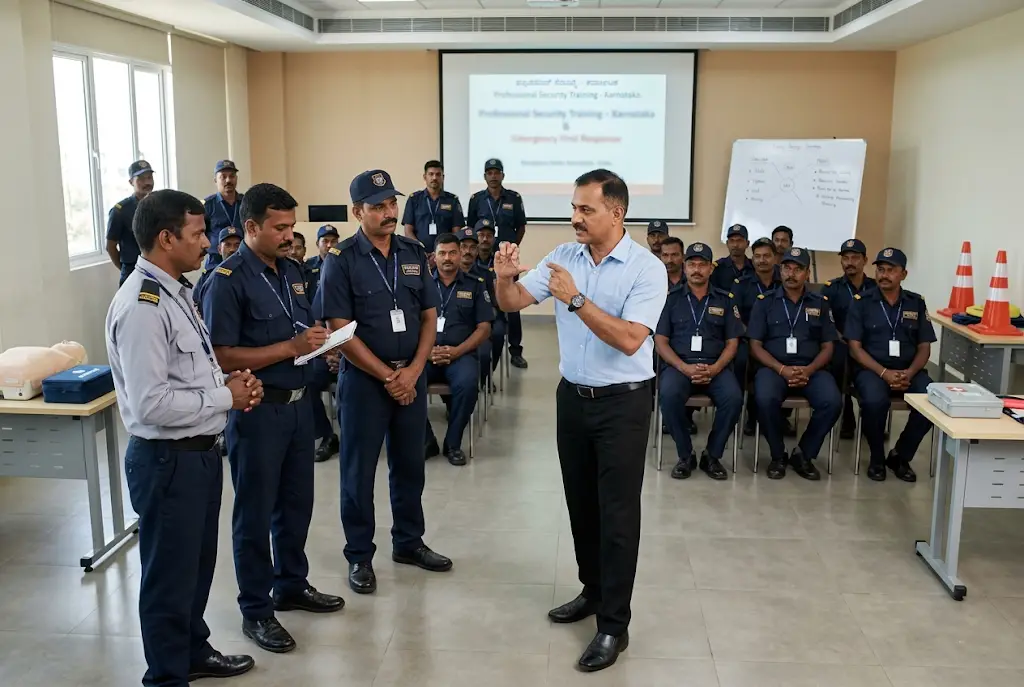
Karnataka rules require training for private security guards. The training covers practical areas such as public conduct, uniform discipline, physical security, firefighting, crowd control, checking ID documents, first aid, crisis response, and basic legal awareness.
A standard training period may include classroom instruction and field training. Ex-servicemen and former police personnel may qualify for a shorter training route as per the rules.
Training is not a formality. It affects service quality, client trust, and license compliance.
7. Maintain Supervisor Ratio
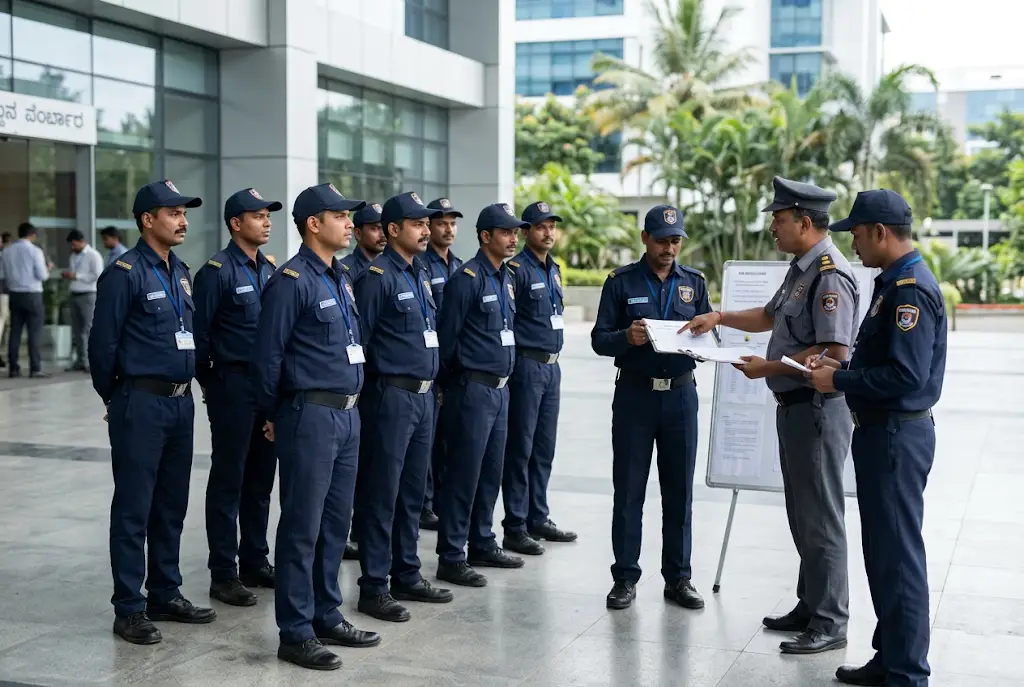
Security guards need supervision. Karnataka rules provide a supervisor requirement so that guards are not deployed without proper oversight.
As a practical rule, plan your manpower structure before signing client contracts. If you deploy guards at multiple sites, you must have enough supervisors to manage attendance, discipline, emergency response, uniform checks, replacement guards, and client reporting.
8. Register for GST, If Applicable

Security services are taxable services under GST. GST registration and filing become important when your aggregate turnover crosses the applicable threshold, when your client requires GST invoices, or when GST law otherwise requires registration. The official GST tutorial portal explains the normal taxpayer registration process through the GST portal.
Many security agencies take GST registration early because corporate clients, apartments, institutions, and facility management contracts usually expect GST invoices.
Once registered, you must file GST returns on time. If you collect GST and fail to file returns or pay tax, it can create cash flow issues, penalties, and client disputes.
9. Handle Professional Tax, PF, and ESI

Security agencies are manpower-heavy businesses. Labour compliance matters from the beginning.
In Karnataka, Professional Tax registration may apply to businesses and employers. Employers can check registration, filing, payment, and updates on the Karnataka Professional Tax portal. If you employ staff, you must check employer registration and deduction duties.
PF registration generally applies when an establishment crosses the employee threshold under EPFO rules. The EPFO website has a dedicated employer guidance section for registration, returns, and online contribution payment. ESI registration generally applies to covered establishments and eligible employees as per ESIC rules, and employers can refer to the official ESIC portal for scheme and employer updates. Since security agencies often grow quickly, you should plan PF and ESI from the first hiring stage instead of waiting for a notice.
Maintain salary sheets, attendance, appointment letters, wage records, UAN details, ESI numbers, and monthly payment proofs.
10. Issue ID Cards, Uniforms, and Maintain Records
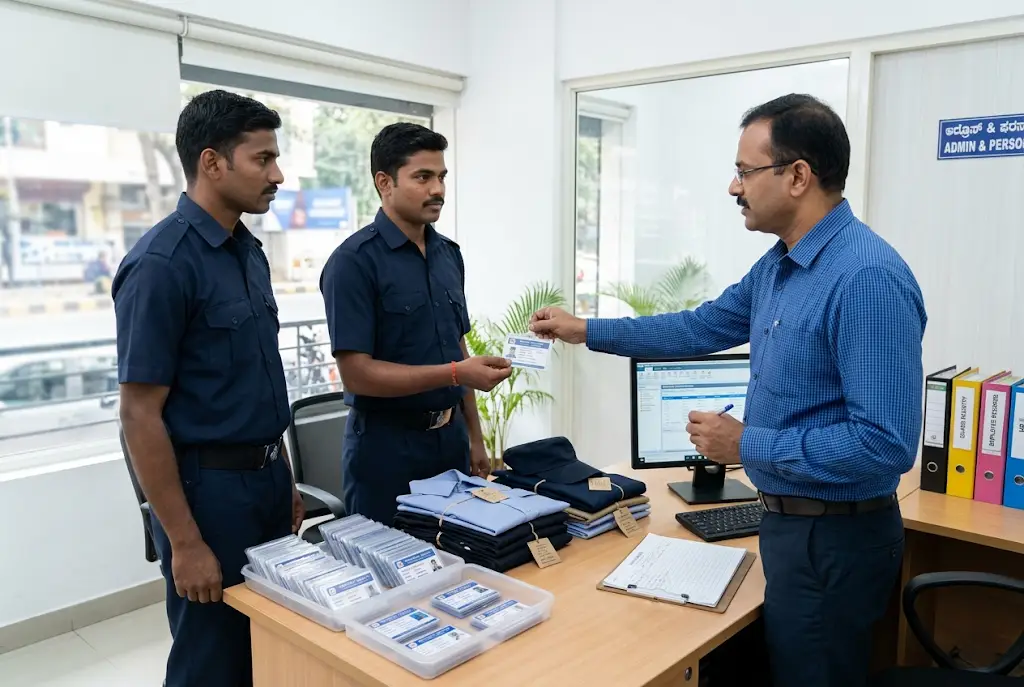
A private security agency should maintain proper employee and client records. Guards and supervisors should carry identity cards issued by the agency. Uniforms, badges, and identity details should not create confusion with police, armed forces, or government authorities.
Maintain records for:
• Owners, partners, directors, and managers
• Guards and supervisors
• Client sites where guards are deployed
• Salary and attendance
• Training completion
• Police verification
• Uniform and ID card issue
• Complaints and incidents
• Contract copies and invoices
These records may be checked during inspection or client audits.
A 30/60/90-Day Founder Planning Sequence (Not a Government Timeline)
The periods below are internal planning phases, not statutory processing promises. The Act’s decision framework applies after a complete application and required verification; actual timing depends on the authority, the file and any clarification requested.
| Planning phase | Founder actions | Gate before moving on |
|---|---|---|
| Days 1–30: business foundations | Choose the entity; establish tax and banking basics; identify premises; define service area and operating model. | Confirm who the applicant is and which registrations are actually applicable. |
| Days 31–60: PSARA readiness | Prepare current applicant, premises, antecedent and training-arrangement evidence; review the PSARA document checklist. | Resolve mismatches and use current Karnataka authority requirements. |
| Days 61–90+: filing and pre-operation | Submit through the operative process; respond to lawful queries; finalise labour, tax and local compliance where applicable. | Start regulated operations only after the required approval; use the conditional licence matrix for related registrations. |
Estimated Timeline to Start a Security Agency in Karnataka
Timelines can vary based on documents, police verification, training arrangements, department workload, and whether you apply for one district or the whole state.
Stage | Practical Timeline |
|---|---|
Entity registration and PAN setup | 7 to 15 working days |
Office, Shops Act, GST, and basic registrations | 7 to 20 working days |
PSARA document preparation | 5 to 10 working days |
Police verification and department review | 30 to 90+ days |
Full operational readiness | 45 to 120 days |
The PSARA law gives a time framework for the authority to grant or refuse a license after the complete application and fee are received. In practice, delays happen when documents are incomplete, address proof is weak, police reports take time, or training records are not clear.
Common Mistakes to Avoid
Keep this page focused on sequence. For the detailed risk analysis—such as inconsistent applicant details, incomplete records, training-arrangement gaps and incorrect jurisdiction assumptions—use the separate PSARA mistakes and delay-risk guide.
Before filing, cross-check the Karnataka PSARA evidence checklist. Related GST, labour and local registrations are conditional; review the security-agency licence matrix instead of assuming every row applies.
Special Note on Cash Transportation and ATM Security
If your agency wants to provide security for cash vans, ATM cash loading, or bank cash movement, you must follow stricter rules. Karnataka has specific rules for private security in cash transportation activities.
These rules deal with secured cash vans, trained staff, armed guards, cash handling areas, CCTV, vault security, timing restrictions, KYC, and police verification. This is not the same as ordinary apartment or office security.
If you plan to enter this segment, take expert guidance before quoting for bank or cash logistics contracts.
How Kickstartbiz Helps You.
Most new security agency founders focus on getting clients first. That is understandable. But in this business, compliance should come before aggressive sales.
Here’s the practical way to think about it: a security agency sells trust. Your client is not only buying manpower. They are trusting you with entry gates, staff movement, visitor logs, assets, vehicles, residents, children, patients, machines, and sometimes cash.
So your setup must prove three things:
- Your business is legally allowed to provide security services
- Your guards are verified, trained, and supervised
- Your payroll and labour compliance can stand up to client audits
At Kickstart Business Advisors LLP, we usually suggest building the setup in layers: first, business registration and office documents, then PSARA preparation, then GST and labour registrations, then employee records and monthly compliance. This avoids last-minute confusion when a client asks for documents before signing a contract.
When Should You Consult a Professional?
You should consult a professional if:
- You are unsure which entity type to choose
- You want to operate in more than one district
- Your directors or partners have address changes or complex documentation
- You need PSARA, GST, Shops Act, PT, PF, and ESI together
- You plan to work with corporations, apartments, banks, factories, or institutions
- You want to provide armed guard or cash transportation services
- Your earlier PSARA application was delayed, rejected, or returned
A professional can help you check documents before filing, avoid mismatches in registrations, prepare affidavits, guide police verification paperwork, and plan the right compliance sequence.
FAQs on Starting a Security Agency in Karnataka
What is the first step to start a security agency in Karnataka?
The first step is to choose and register your business entity. After that, set up an office address and prepare for the PSARA license application, police verification, GST, Shops Act, and labour registrations.
Is the PSARA license mandatory for a security agency in Karnataka?
Yes. A business that provides private security guards or security services to clients in Karnataka needs a PSARA license before operating as a private security agency.
Can I start a security agency in Bengaluru with one license?
Yes, if your PSARA license covers the district or area where you operate. If you want to serve more districts in Karnataka, choose the correct jurisdiction while applying.
How long does it take to get a PSARA license in Karnataka?
A practical estimate is 45 to 120 days for full setup, depending on documents, police verification, training compliance, and department processing. Timelines can vary.
Do security guards need police verification?
Yes. Security guards and supervisors should undergo character and antecedent verification as required under PSARA and Karnataka rules. Agencies should keep these records updated.
Is GST registration required for a security agency?
GST registration is required when the agency crosses the applicable turnover limit or when the GST law otherwise requires it. Many agencies register early because clients usually need GST invoices.
Do security agencies need PF and ESI registration?
PF and ESI may apply when the agency crosses employee thresholds or employs eligible staff under the law. Since security agencies hire many guards, they should plan PF and ESI compliance early.
Can an ex-serviceman start a security agency in Karnataka?
Yes, an ex-serviceman can start a security agency if they meet PSARA eligibility, business registration, police verification, and compliance requirements. Their background may help with operations and training discipline.
Conclusion
Knowing how to start a Security Agency in Karnataka is the first step. Doing it correctly is what protects your business.
You need more than a business name and a few guards. You need a compliant setup with a PSARA license, proper office documents, police verification, guard training, GST, Shops and Establishment registration, Professional Tax, PF, ESI, and clean employee records.
If you plan to start a security agency in Bengaluru or anywhere in Karnataka, Kickstart Business Advisors LLP can help you with full setup support, including business registration, PSARA registration, GST, labour registrations, and ongoing compliance guidance. For expert help, contact Kickstart Business Advisors LLP or visit the PSARA registration service page.